The Seven Steps to Becoming a PI - A Blueprint for Rookies
Updated: Apr 13
Becoming a private investigator is an exciting journey, and there’s no single path.
While some suggest starting in the police, military, or security fields, many successful private investigators come from ordinary—or even unusual—backgrounds.
The journey of becoming a private investigator may be long, but it begins with your first step. So let’s get moving!
The Seven Steps to Becoming a PI - A Blueprint for Rookies
Step One: Self-Assessment
First, take stock of your background, skills, and traits.
Take a look at the box below and make a list of all that apply to you.
Relevant Backgrounds, Skills, and Traits of Successful Private Investigators
Backgrounds
Military
Mom
Sales
Management
Photography
Acting
Law Enforcement
Social worker
Teacher
Construction
Criminal Justice
Spy
Guard / Protection
Skills
Problem Solver
Talker
Persuasive
Analytical
Computer
Internet
Tech – (e.g. cameras)
Vehicles
Drones
Reporting
Interviewing
Writing
Calculating
Traits
Independent Thinker
Good with People
Persuasive
Tough
Persistent
Intuitive
Doesn’t give up
Can handle stress
Remembers facts
Observant
Realistic
Honest
Can-do
You don’t need all of these—some PIs simply drive and take photos for a living, and that alone can be enough to succeed.
When very young people (18–20) ask me about preparing for a career as a PI, I tell them to start with simple jobs like driving for Lyft; it teaches city navigation and social skills, and offers total flexibility, meaning you’re available to take a case or mission at any time.
Your PI niche will determine which skills matter most.
For example, a PI with expertise in art or machinery can specialize in investigating related crimes. If you’re fortunate enough to have highly relevant skills—such as a military policeman or a forensic accountant—you can lean into that immediately.
I guarantee that someone, somewhere, needs your help.
But don’t forget to choose one or two niches that are completely different. Your goal should be to become a competent PI in 2 to 5 areas of specialization.

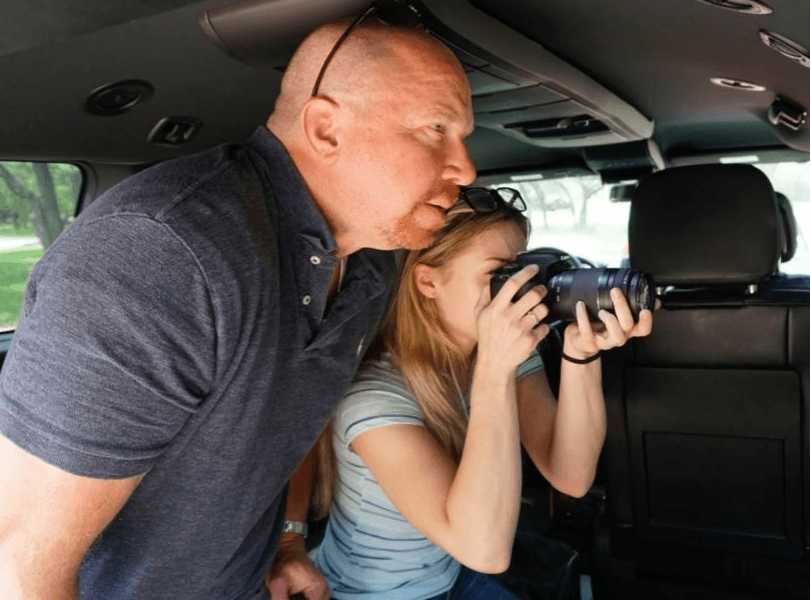
Personally, I can’t say no to a unique case. I love to learn. The downside is that new cases require 3x the effort to deliver for the client, so I usually don’t make money on them. But they’re fun!
Who Can Become a Great PI?
Becoming a great private investigator isn’t predictable; some rookies succeed against all odds, while others struggle.
I often tell people, “I’m barely a 6/10! But I win a lot.”
Our team at StriderPI wins for three reasons:
1. We plan and work smart.
2. When we have a plan, we go for it (fortune favors the brave.)
3. Everyone on the team is better than me; I insist on it.
Key Question: Do You Have Persistence?
The most important trait for a private investigator is persistence.
Can you stay on a case for weeks or months, chasing leads even when the odds are against you? Can you handle threats or bribes?
I’ve faced threats from a south Austin gang, individual gang members, a former Mexican mafia enforcer, a mafia “cousin of Sammy the Bull”, and others. I’ve also had an attorney who offered $1m of business as a bribe—if we would let him edit one of our major case investigative reports. He also threatened “You’ll never work again…” Nice guy. Still undermining the law in Houston to this day.
The beauty of a PI career is that you can choose your niche—avoiding dangerous situations if you want.
The next question to ask yourself is:
What would you enjoy doing—and do you have what it takes to learn it and follow through?
What Backgrounds Make a Strong PI?
I've seen several successful PIs come from a wide range of backgrounds:
Moms: responsible, good time managers, empathetic
Entrepreneurs: self-reliant, problem solvers
Tradespeople (Construction, Plumbers): hands-on, reliable, fieldwork-ready
FBI Agents: high standards, fearless in dangerous situations
Digital Experts/Nerds: natural OSINT and tech skills
Photographers: obviously have an edge in fieldwork; cameras are the “guns” of PI field agents.
Military and Law Enforcement: experienced with high-risk investigation—and it shows.
Former military and police have an edge: they understand chain of command, secrecy, teamwork, and mission focus—skills civilians must quickly learn to succeed in the PI field.
Traits That Matter Most
A personality assessment of my team highlighted the traits that define top PIs:
Independence
Persistence
Creative problem-solving
Curiosity and willingness to learn
I was in Italy recently and met a former Italian paratrooper who was working as a doorman in a sleepy little apartment building. His paratroop experience showed he was up for adventure and possibly a very good field agent, but he had been doing that doorman job for 20 years! It’s hard to imagine someone curious enough to be a PI doing the same job for so long. He would probably not make a good PI. But, many people have surprised me.
Are You Ready to Become a PI?
Do you feel you have in it you to make it as a PI?

That’s going to be the most important question and the only one that matters in my opinion.
Relevant skills help, but the job is mostly a learning curve; everyone starts somewhere and grows to handle a variety of cases.
If your instinct says yes, go for it. Otherwise, you’ll always wonder what could have been.
Step Two: Choose Your Private Investigator Path
Take some time to think about the kind of PI you want to be.
You don't have to decide immediately, but your choice will guide your training and experience.
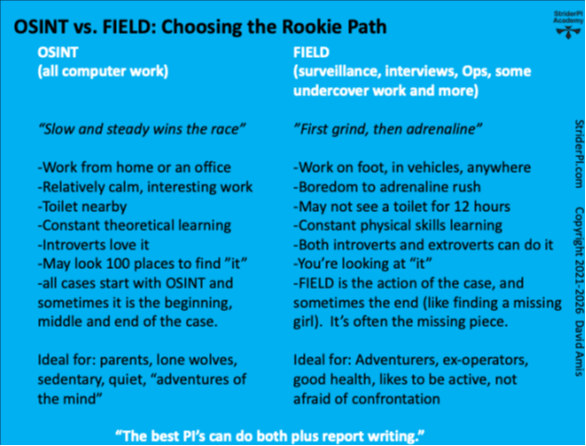
A. OSINT vs. Field: Your First Decision
The first major decision is whether you want to work primarily as:
An OSINT agent: conducting research and investigations online
A Field agent: surveillance, interviews, undercover work, and on-the-ground investigations
Both: the best PIs do both well.
Personally, I’m stronger in fieldwork and team leadership, so I always pair with a skilled OSINT specialist on cases.
Start learning now—whatever it takes. Think about the kinds of cases you want to work.
Becoming a competent PI usually takes about two years before you really find your footing. After that, it’s “go time!”
B. Selecting Your Private Investigator Niche
Here’s a list of case types I've identified over the years.
80 Private Investigator Niches©
Abductions
Accident Reconstruction
Adoption Searches
Arson/Fire
Asset Recovery
Asset Search
Animal Investigations
Background Checks
Bounty Hunter
Bug Sweep, Bug Detection
Cell Phone Specialist
Child Support / Custody
Civil Investigations
Cold Cases
Computer Forensics
Corporate/Industry
+Oil
+Insurance
+Baking
+Ships
+Transportation
+Hundreds of others
Crime Scene
Criminal Defense
Cyber Crime
+Deep Background Checks
Divorce and Child Custody
Domestic Disputes
Domestic Violence
Due Diligence
Elder Abuse
Electronic Data Discovery
Executive Protection
Executive/Corporate Lawsuits
Forensic Accounting
Financial Crimes
Forensics – General
Fraud
Fugitive Recovery
Homicide
Hotel
Human Trafficking
Identity Theft
Infidelity/Cheating Spouse
Insurance Fraud
Internet Dating Investigation
Interview and Interrogation
Judgment Recovery
Kidnapping
Litigation support
Locates
Malpractice Suits
Medical Malpractice
Missing Heirs
Missing Persons
Mystery Shopper
Nursing Home Abuse
Personal Injury
Polygraph
Process Service
Public Record Retrieval
Repossession
Risk Assessment
Runaways
Sex Trafficking
Sexual Assault
Skip Trace
Social Media
Surveillance
+Electronic Surveillance
+Drone Surveillance
+Photo (Traditional) Surveillance
Suspicious Suicides
Terrorism
Threat Management
Trial Preparation
Undercover Operations
White-Collar Crime
Worker’s Compensation
Wrongful Death
Choose 5 to 10 that are interesting to you and start learning about them.
If you’re wondering, I've worked at least 40 different kinds of cases and about 400 cases in total. I specialize in cases involving money—fraud, theft, and burglary. My niche is major-case fraud. I’m pretty handy at locates and missing persons, which I consider to be rescues. For most other cases, I partner with specialists.
Attending conferences, taking training classes (in-person are best for rookies) and getting started any way you can, will help you find your niche. You may already know your niche, but if not, give it two years.
Just get out there.
Step Three: Build and Execute your own Private Investigator Training Plan
The Three Foundational Skills Every PI Needs
The three foundational skills are OSINT, Surveillance, and Report Writing. These allow you to work case types like infidelity, worker's comp, and locates. That’s where you begin. You cannot succeed without understanding these three areas. Read more about these here.
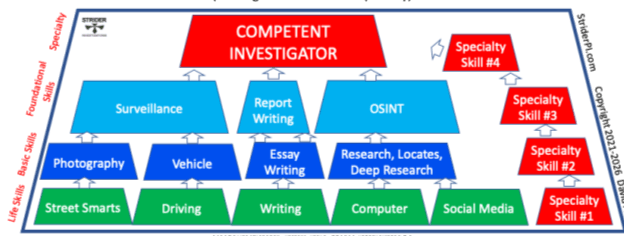
Choosing and developing specialty skills comes next. This is how you move toward working the cases you want.
Decide what kind of PI you want to be and start moving in that direction. Even watching documentaries can help clarify your interests.
For example, if you want to do repossessions:
Take a course
Work for someone who does it (for free if necessary to get started)
Consider working for an insurance company in their lost vehicles department
Learn all vehicle types so you can recognize them instantly
Study the statutes and rules governing vehicle repossessions in your state
Remember—what you see on TV isn't always reality. About 50% of what we see on PI shows actually happens, mostly the weird and crazy stuff. The other half isn't realistic.
Repossessions aren't just about stealing cars back from drug dealers. I know one guy who only repossesses planes—that would be fun! Another recovers boats all over the world and earns a hefty fee each time. Personally, I only do repossessions for high-value vehicles or attorneys I know and respect.
Financial Crimes: My Specialty

Because I already had a strong background in finance—15 years of work experience plus an MBA—I decided to make financial crimes my specialty. It didn’t hurt that I had already “investigated” two fraud cases in my previous career as a CEO and consultant.
The first thing I did was buy a cool shirt! Every PI needs a theme song, a nondescript car, some cool equipment, and at least one shirt you never wear out of the house. The next thing I did was get on every financial-crime cases I could, starting small.
Certified Fraud Examiner Training
After a few months, I applied for and completed the Certified Fraud Examiner’s (CFE) Course with the Association of Certified Fraud Examiners.

CFEs are essentially super financial crime-fighters and consultants. Unlike other PIs, CFEs can make recommendations on financial controls. And unlike accountants—even forensic accountants—they can pick up a thread in any financial document and follow it as far as it goes.
One case led to another, and eventually I was handling very large fraud cases that required up to nine other investigators and researchers.
That’s how I finally found my niche.
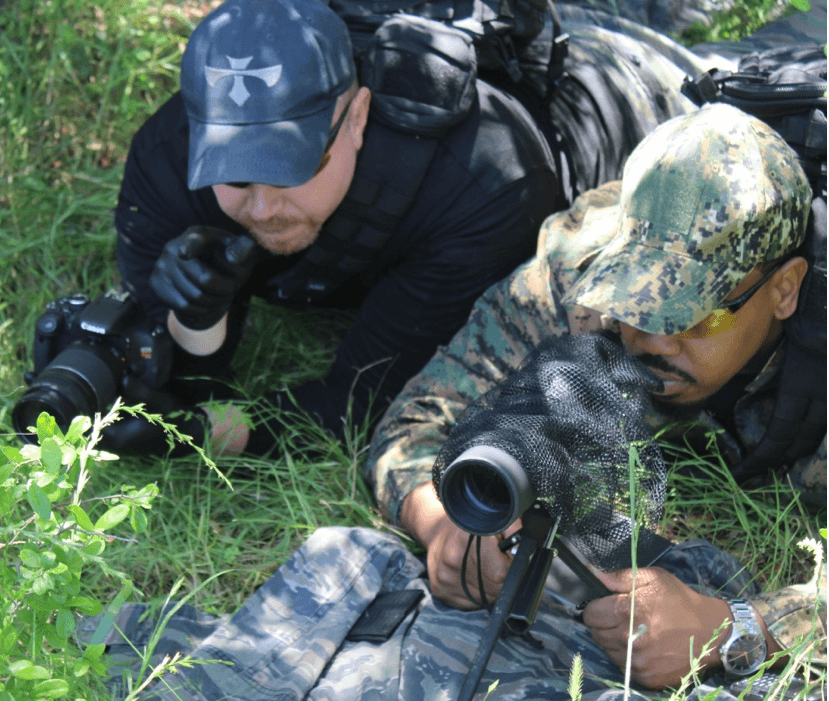
Some of My More Unusual PI Cases
But that’s not the end of the story. I later discovered I have a condition—one that makes it hard for me to say no to a new kind of case! So even though I work major fraud cases, I’ve ended up with plenty of unusual cases.
Here are a few examples:
An 80-year-old mother in Paris, speaking only French, asked me to find her unresponsive adult son. I located him and spoke to him on his porch one winter day—he ended up in tears as I urged him to call her.
A young woman in the Philippines hired me to track down a man in the U.S. for unpaid child support. We found him in a Utah jail; the case involved abuse and was referred to the appropriate agencies.
A mother in rural Texas was confronted by three men demanding credit cards in her name. She refused and captured their license plate. Working with a former Texas Ranger, we identified them within three hours.
A young man asked about his biological father, who had offered him a job. A quick background check revealed extensive convictions, over a decade in prison, and possible cartel ties—we advised him to walk away.
Create Your Own PI Academy

I sat down one day during my first year to address my own training challenges in becoming a PI.
I wanted to recreate my Police Academy experience as best as possible. My police academy was 650 hours of night school, five nights a week, plus every other weekend.
In my first year as a PI, I took about 350 hours of courses. I also took any cases I could get—even if they paid nothing.
It turns out you can work missing-persons cases if they’re public, meaning a law enforcement agency has posted them. Just use OSINT—don’t approach. It’s great for learning.
Anywho, if you imagine the skills needed to do the kinds of cases you want, and discuss it with a mentor (or get in touch with us), you should be able to create a solid 1 to 2 year plan to turn yourself into that person.
Step Four: Order your Equipment

Essential Private Investigator Equipment
First start with the basics—a camera for surveillance and a computer for OSINT.
Later add:
OSINT Operations

A dedicated computer
A dedicated and lockable space for working
A VPN or other way to mask or misdirect any IP address hunters or counter-hunters.
A “Sock Puppet”—essentially an online identity you can use to safely investigate (note: this is a “digital/virtual piece of equipment”)
Field OPs
Build kits. I have kits for:

Basic surveillance (your smartphone, a digital camera with a 75-300 zoom )
Long-range surveillance (long-range sniper scope, plus anything to blend in or hide the equipment)
Rural Surveillance (camos, netting, pad, radios, etc.)
High-Risk contacts (Glock-17, Shotgun, Body Armor, Gun Wound Kit, Blood Type Tags, etc.)
Multiple Day Ops (Energy bars, water, toilet paper, sleeping bag—the basics)
Camera Recommendation for Private Investigators

Don't spend a lot of money on your camera. I tell everyone: just get a Canon Rebel T3. They're all refurbished at this point, and you can get one with a 75-300 zoom for about $350. Rugged and reliable.
Having equipment is fun.

Step Five: Set Up Your Office
I know a couple of guys who have no office. One says,“wherever my laptop is, that’s my office.” But most of us do have offices.
PI Data providers generally require that you have a lockable office and will either inspect it or require pics.
Basic Office Elements:

Computer
Printer
VPN
Lockable File Cabinet
Lockable Door
Secure Cloud
Safe
Pens, paper, maps, etc.
And…..WHITEBOARDS!
I consider the whiteboard to be one of the most valuable case-solving tools. Just throw it all on the whiteboard, sit back, and see what you see. We've developed lots of leads that way, observed lots of connections, and seen many solutions.
Step Six: Get Your Private Investigator License
How to Get a PI License: Requirements and Process
Anyone 18 to 88, who is not a felon, and has no misdemeanor crimes of moral turpitude, can become a licensed private investigator. That’s the baseline.
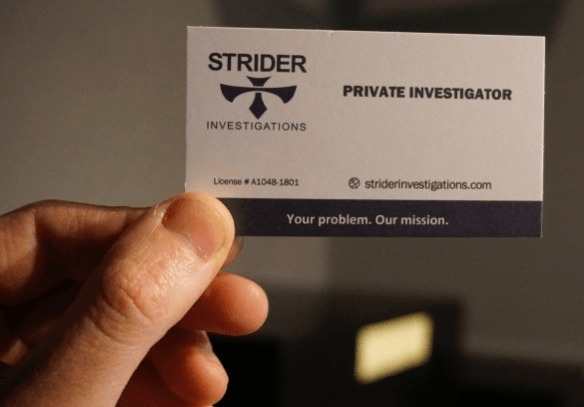
Check your state’s rules—some will be different. In Texas, Statute #1702 is the governing document for licensed PIs and includes private investigator qualifications.
How Do You Become a PI? The Licensing Process
Licensing starts with the Department of Public Safety in Texas. The process itself is straightforward in theory—but navigating it is anything but. We call it the "Quagmire." Most wannabe PIs get stuck there for a year or more. I did too.
At StriderPI, we walk you through it. Our success rate is about 90%, as final approval rests with the State of Texas.
Private Investigator License Options
The process involves deciding whether to set up your own company (i.e. a “licensed private investigations company”) or sign up with a current firm to get your individual PI License.

Your Options
Set up your own licensed investigations company
Sign on with an existing firm to earn your individual PI license
A North Texas college reportedly offers a licensing route—though I've yet to meet a PI who came through it
The DIY approach: submit fingerprints, complete the forms, and assemble your application folder yourself
Going solo means navigating DPS requirements alone, with plenty of room for delays or mistakes. You can follow the licensing guide in this blog—or join one of our SPIT classes and we'll walk you through it step by step.
Step Seven: Start-Up Strategies
The 6 Strategies to Become a Private Investigator
I’ve spoken with hundreds of PIs—these are the six strategies they use most.
TORTOISE (aka “Stick Your Toes In”)
This is the slow, part-time path into private investigation—one step at a time. Start with a short online course, attend a conference, or pick up small, part-time work. Many take this approach to test the waters while keeping their primary job. It’s practical, low-risk, and lets you build experience before fully committing.
NETWORKER
Start by meeting everyone you can. Join TALI as an associate member, attend Zoom meetings and conferences, and get involved. You’ll connect with experienced PIs, gain practical advice, and quickly learn where the real opportunities—and income streams—are in the industry.
SPECIAL FORCES
Train aggressively. Go all in on education and skill-building from day one. In my first year as a Texas PI, I logged 300 hours of training, followed by 200 more the next year, and another 300 through the Certified Fraud Examiner program. If you have the resources, this path lets you enter the profession highly prepared and ready to perform.
SINK OR SWIM
Jump in fast—get hired by a firm and learn on the fly. It’s a high-risk, high-reward approach where experience comes quickly, but mistakes can be costly. Many go through a few hard lessons early on, but for those who stick with it, the learning curve is steep and fast. I was fired after three weeks at my first firm for a major mistake, and six months at my second for “asking too many questions.”
DOUBLE-BLADED
Start your own firm while working for an established PI. Be transparent—firms don’t own your time unless you’re full-time, but honesty is key. Always maintain strict confidentiality, including between firms.
ACADEMY YEAR
Do what I did and figure out a way to take all the casework you can get for a year. If you can’t get enough work as a PI, then work as an office manager, assistant, gopher, or technician. But go for it. Whatever it takes, get started working in any way possible and get as much experience as you can. Learn by doing.
Rookie PI Hack: Start With Fidelity Cases
I suggest to all new PIs that they start with fidelity cases. All you need to do these cases are basic surveillance skills, basic report-writing skills, basic photography skills, and a little mentoring. This is a great way to become a private investigator. It’s also a great way to make money, develop your surveillance skills, and have some fun. Get good at that in 6 to 12 months, and then move to the next thing on your list.
At the end of the day, there’s no perfect background or ideal starting point—just people who get moving, build skills, and stick with it. Whether you start with fidelity cases, jump into training, or try out a few different niches, it all comes together one step at a time.
That’s the idea behind The Seven Steps to Becoming a PI – A Blueprint for Rookies: a straightforward path to help you get started and keep going.

Becoming a private investigator is entirely achievable—it's up to you. Choose your strategy, set your target, and get going! - Dave Amis


Comments