OSINT Training for Texas Private Investigators: What You’ll Actually Learn

OSINT — open-source intelligence — is the practice of gathering information from publicly available sources: social media, public records, court filings, business registries, and archived web data.
For Texas private investigators, OSINT is no longer a specialty. It's baseline.
Twenty years ago, OSINT was something a handful of tech-savvy investigators did on the side.
Today, it's the first move on nearly every case that walks through the door — a skip trace, a background check, a due-diligence request, an infidelity case that starts with a name and a phone number.
Clients expect it. Attorneys expect it. And the investigators who haven't built real proficiency in it are increasingly the ones losing work to the ones who have.
What Counts as "Open Source" in an Investigation
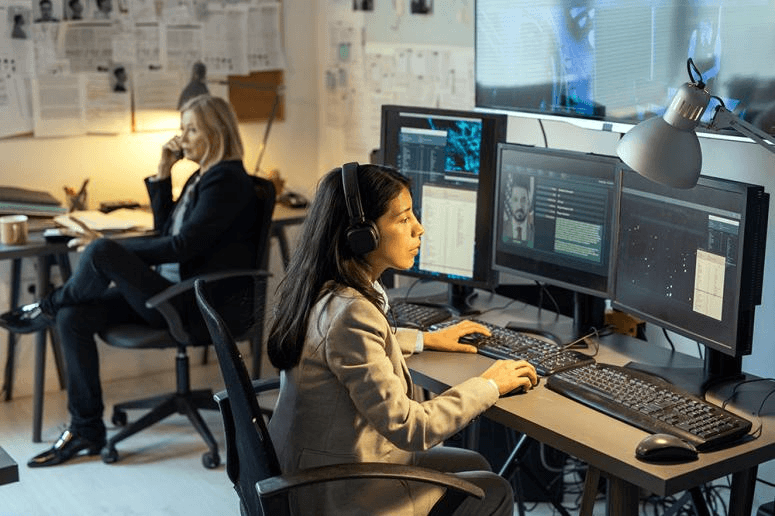
OSINT doesn't mean free, and it doesn't mean easy to find; it means available to anyone, even when accessing it takes a paid database, a records request, or specialized search technique.
The "open" in open-source intelligence refers to legal accessibility, not cost or convenience — a court clerk's fee to pull a filing doesn't make that filing any less public.
Understanding this distinction matters, because it's exactly where new investigators tend to get confused about what's fair game and what isn't.
Commonly used categories include:
Source Type | Examples | What It Typically Reveals |
Public records | Property, court, business filings | Ownership, litigation history, corporate ties |
Social media | Facebook, Instagram, LinkedIn, X | Associations, location patterns, timeline of activity |
Records databases | County/state licensing, UCC filings | Assets, liens, professional credentials |
Media & archives | News archives, cached web pages | Historical statements, prior incidents |
Geolocation data | Public GPS metadata, mapping tools | Movement patterns, property boundaries |

Each of these categories has its own quirks. Property and court records vary widely by Texas county in how they're indexed and how far back digital records go. Social media platforms constantly change what's visible without a login, which means a technique that worked last year may not work today.
Records databases often require knowing which specific registry applies to the case — a UCC filing search and a professional licensing lookup are not the same tool, and using the wrong one wastes time a client is paying for.
Why OSINT Has Become Core to Private Investigations
A large share of investigative work — locating someone, verifying a claim, building a background profile — now starts and often ends at a keyboard rather than in the field.
Even cases that eventually require boots-on-the-ground surveillance usually begin with an OSINT pass: confirming an address, identifying a vehicle, mapping out someone's daily patterns before a single hour of physical surveillance is logged.
Done well, it saves client money and investigator time. Done poorly, it sends both down the wrong road entirely.
An investigator without solid OSINT training is working with one hand tied, regardless of how strong their surveillance or interview skills are.
Field skills answer "what is happening right now." OSINT skills answer "who is this person, what's their history, and where should I even be looking." Without that second piece, the first one has nowhere to point.
What Texas Private Investigator Training Should Cover for OSINT
Good training goes past "how to search someone's name." It should build:
Public records literacy — knowing which Texas county, state, and federal databases exist and what they actually contain, so time isn't wasted searching the wrong registry or assuming a record exists digitally when it's still paper-only in a given county.
Social media investigation — verifying identity and cross-referencing accounts in a way that holds up later, including recognizing fake or dormant profiles, archived versions of deleted content, and the difference between an account belonging to the subject versus someone with the same name.
Legal boundaries — what's public record versus what requires a subpoena, consent, or a licensed data-broker relationship, and understanding that the line isn't always intuitive — some data feels public but legally isn't, and vice versa.
Documentation discipline — a finding is only useful if it's sourced, dated, and reproducible, because an investigator's notes may end up in a report an attorney relies on, or in testimony months after the search was run.
The Biggest OSINT Mistake: Information Without Verification
The biggest OSINT mistake isn't failing to find information — it's failing to verify it. A same-name match, an outdated address, a spoofed profile: any of these can send a case sideways.
This is where inexperienced researchers get burned. A search engine will hand back results with total confidence whether they're accurate or not, and the tool has no way of flagging "this is probably the wrong John Smith." That judgment call belongs entirely to the investigator.
Training that teaches search without teaching verification is incomplete. Finding a name, an address, or a social media profile is the easy part — cross-checking it against independent sources, noting when confidence is low, and being willing to say "unconfirmed" instead of guessing is the skill that actually protects a case (and the investigator's credibility) down the line.
OSINT Skill Checklist

Can identify which Texas public-records databases apply to a given case type
Can cross-verify a social media identity against at least two independent sources
Understands the line between public record and data requiring legal process
Documents every finding with source, date, and method of access
Flags unverified information as unverified rather than presenting it as fact
FAQs
Is OSINT legal for private investigators to use?
Yes — OSINT relies on publicly available information. The legal risk isn't in accessing public data, it's in how that data is obtained, verified, and used afterward. Scraping a platform in a way that violates its terms of service, or misrepresenting oneself to obtain access to non-public information, can turn an otherwise legal research practice into a liability.
Do I need a license to do OSINT work in Texas?
Texas requires private investigator licensure, administered by the Texas Department of Public Safety's Private Security Program under Texas Occupations Code Chapter 1702, for investigative services performed for compensation. Training in OSINT skills is separate from licensure — check current requirements directly with DPS.
How is OSINT taught differently in PI training versus general "internet research" courses?
PI-focused OSINT training ties the research skill to case use — documentation standards, legal boundaries, and how findings get used in a report — rather than teaching search technique in isolation. A general internet-research course might teach someone to find information faster; it won't teach them how that information needs to be sourced and preserved to be useful if a case ever ends up in front of a judge.
Sources
Texas Department of Public Safety, Private Security Program — Private Investigator Licensing Overview
Texas Occupations Code, Chapter 1702 (Private Security Act)
Tracers, "What is Open-Source Intelligence (OSINT)?"
Varonis, "What is OSINT?"


Comments